
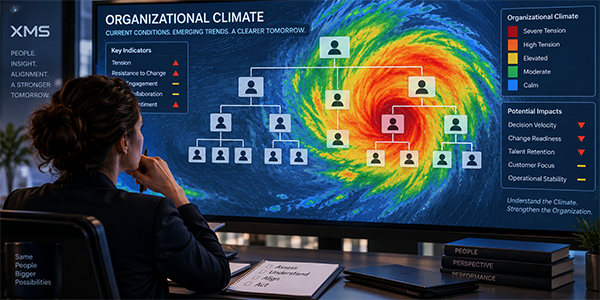
Organizational Climate describes how members affectively experience their organizational environment at a given time, particularly through the organization’s level of Organizational Tension and Resistance to Change. There is no universally ideal Organizational Climate. The most effective Climate is the one aligned with the organization’s strategy and design. The goal isn’t obtaining some sort of universally better Organizational Climate. The goal is finding the right Organizational Climate.
But how do you know whether you have it? You assess it. An Organizational Climate Survey can be remarkably simple. For example, consider the following survey designed for an allocentric organization (i.e., one that emphasizes adaptability, distributed decision-making, and responsiveness to its external environment).
Example: Organizational Climate Survey for an Allocentric Organization
Ask members of the organization to indicate how strongly they agree or disagree with each statement:
- I feel like our organization can handle any change that is thrown our way.
- I am happy, excited, and enthusiastic when I am at work.
- I trust the people that I work with.
- I feel we handle conflict well as an organization.
- I feel like I am rewarded fairly for my contributions.
- My work life does not interfere with my personal life.
- My company supports my growth as an individual.
- We love experimenting with new ideas and are open to changing roles based on new technology.
- Our success is driven more by external factors than internal metrics.
The questions themselves aren’t complicated. What’s important is what they’re designed to assess. This isn’t a generic employee-satisfaction survey intended to determine whether people like working for the organization. It’s an instrument designed to determine whether the organization’s current Climate supports the kind of organization it is designed to be.
Why Assess Organizational Climate?
Organizational Climate is an integral part of OD (Organizational Design). Like other elements of the design, it should align with, reinforce, and harmonize with what the organization is trying to accomplish. An allocentric organization generally benefits from relatively low Organizational Tension and low Resistance to Change. In contrast, an organization designed around centralized authority, specialization, stability, and internal efficiency—what I call an egocentric organization—may require considerably more of both. Neither Climate is inherently better.
That’s why an Organizational Climate Survey shouldn’t assess the Climate against some generic conception of a healthy workplace. It should help leaders answer a more strategically useful question: Does our current Organizational Climate support what this organization is designed to accomplish? And because the appropriate Climate depends on the organization’s design, the survey itself should be designed on the basis of what Climate the organization needs to optimize success.
Organizational Climate can change quickly. A major announcement, leadership change, competitive threat, restructuring, or disappointing quarter can alter how people experience their environment long before anything fundamental about the organization’s design has changed. Assessing Climate gives leaders an opportunity to recognize when conditions have become dissonant with the organization’s design and influence them before the misalignment becomes more consequential.
Three Levels of Climate Assessment
Organizations can approach Climate assessment at different levels of maturity.
Maturity Level 1: On Demand
At the most basic level, leaders assess Organizational Climate when circumstances suggest that an assessment is warranted. That might happen during a large transformation, following a major event or announcement, during Organizational Design work intended to balance, realign, or harmonize the organization, or simply because something feels off.
This approach can be quite effective. The organization maintains an ongoing commitment to assess Climate when conditions warrant it without automatically administering surveys according to a predetermined schedule. But this approach requires leaders to remain conscientious about recognizing when conditions warrant a closer look.
Level 2: Periodic
At the next level, Climate assessment becomes part of the organization’s regular operating rhythm. Quarterly assessment is a reasonable starting point, although monthly or even more frequent assessment may be appropriate if the organization’s culture can comfortably support it. Periodic assessment makes it easier to identify movement over time. Instead of waiting for conditions significant enough to trigger an assessment, leaders can observe changes in Organizational Tension and Resistance to Change as they develop. Major events can still warrant an off-cycle assessment. A quarterly cadence shouldn’t become a reason to wait when circumstances clearly justify looking sooner.
Level 3: Continuous
At the highest level of maturity, Organizational Climate becomes something the organization senses continuously, approaching real time. Climate is one of the relatively few organizational phenomena particularly well suited to continuous assessment because assessment can persist without requiring continuous intervention.
Advanced AI makes this increasingly feasible. For example, the Prophet Center is a concept I’ve developed for continuously sensing and interpreting signals from an organization’s internal and external environment. A capability like this could continuously assess signals associated with Organizational Climate and alert leaders as meaningful changes begin to emerge.
Continuous assessment comes with an important responsibility: transparency. People should understand why Climate is being assessed, how the assessment architecture works, how information will be used, and what the organization is learning from it. Don’t do this behind their backs! The objective is organizational awareness, not clandestine surveillance.
What This Looks Like in Practice
Now consider an egocentric organization—one designed to emphasize stability, specialization, centralized coordination, internal efficiency, and consistent execution. Imagine its leader learns that the organization’s largest competitor has introduced a product that could significantly threaten market share. The news is public, so employees are hearing about it at roughly the same time as leadership. The leader quickly holds a town hall to acknowledge the competitive threat, explain what leadership currently knows, and establish expectations for the organization’s response.
Shortly afterward, the organization conducts an Organizational Climate Survey. But it doesn’t administer the allocentric survey shown earlier. The desired Climate is different, so the survey is different.
Example: Organizational Climate Survey for an Egocentric Organization
Again, ask members of the organization to indicate how strongly they agree or disagree with each statement:
- I feel like our organization is very stable in its operations and there’s no reason to make any changes.
- I am calm, content, and comfortable when I am at work.
- I am very good at my job, I don’t feel like anybody can do my job as well as I can.
- There is a good level of conflict in the organization and we handle it well.
- I’m happy with my compensation, but I feel there’s an opportunity for more rewards, based on my contributions to the company.
- Work sometimes spills into my personal life; however, I’m able to manage it well.
- I feel like my job is stable; however, I wish there were more opportunities for growth.
- It’s fun to experiment with new ideas and changing roles, but not at the expense of our stability.
- Our success is driven by internal metrics for efficiency and process capability.
Notice that this isn’t simply the same survey with different expectations for the scores. The questions themselves reflect the Climate appropriate for the organization’s design.
Suppose the assessment reveals two meaningful issues. First, responses to the statement about operational stability have shifted substantially. The competitive announcement has reduced Resistance to Change: people want the organization to respond. Second, responses concerning conflict indicate that conflict is becoming increasingly distressful. Organizational Tension isn’t simply elevated; it is beginning to manifest in ways that could interfere with organizational performance. Neither finding necessarily means the organization needs to become a fundamentally different kind of organization. It means its current Climate has moved away from the Climate that best supports its existing design.
The leader sponsors focus groups to better understand what people are experiencing and ensure the organization feels heard. Those conversations also engage members of the organization in developing an action plan intended to restore the Climate to a state that better supports the organization’s strategy and design. The Climate Survey didn’t tell the leader how to respond to the competitor. It did something equally important: It revealed what the competitive threat was doing to the organization while the organization was deciding how to respond to it.
Assess Your Organizational Climate
Finding the right Organizational Climate is about creating conditions that support what the organization is designed to accomplish. And because those conditions can change, leaders need a reliable way to recognize when the Climate begins moving out of alignment. An Organizational Climate Survey provides that visibility.
Run an Organizational Climate Survey with your organization today. You don’t need sophisticated AI to begin. Start by asking the most important question: Does our current Organizational Climate support what our organization is designed to accomplish? Then build an assessment appropriate for the Climate your organization actually needs—and have enough gumption to find out what Climate you actually have.

0 Comments